
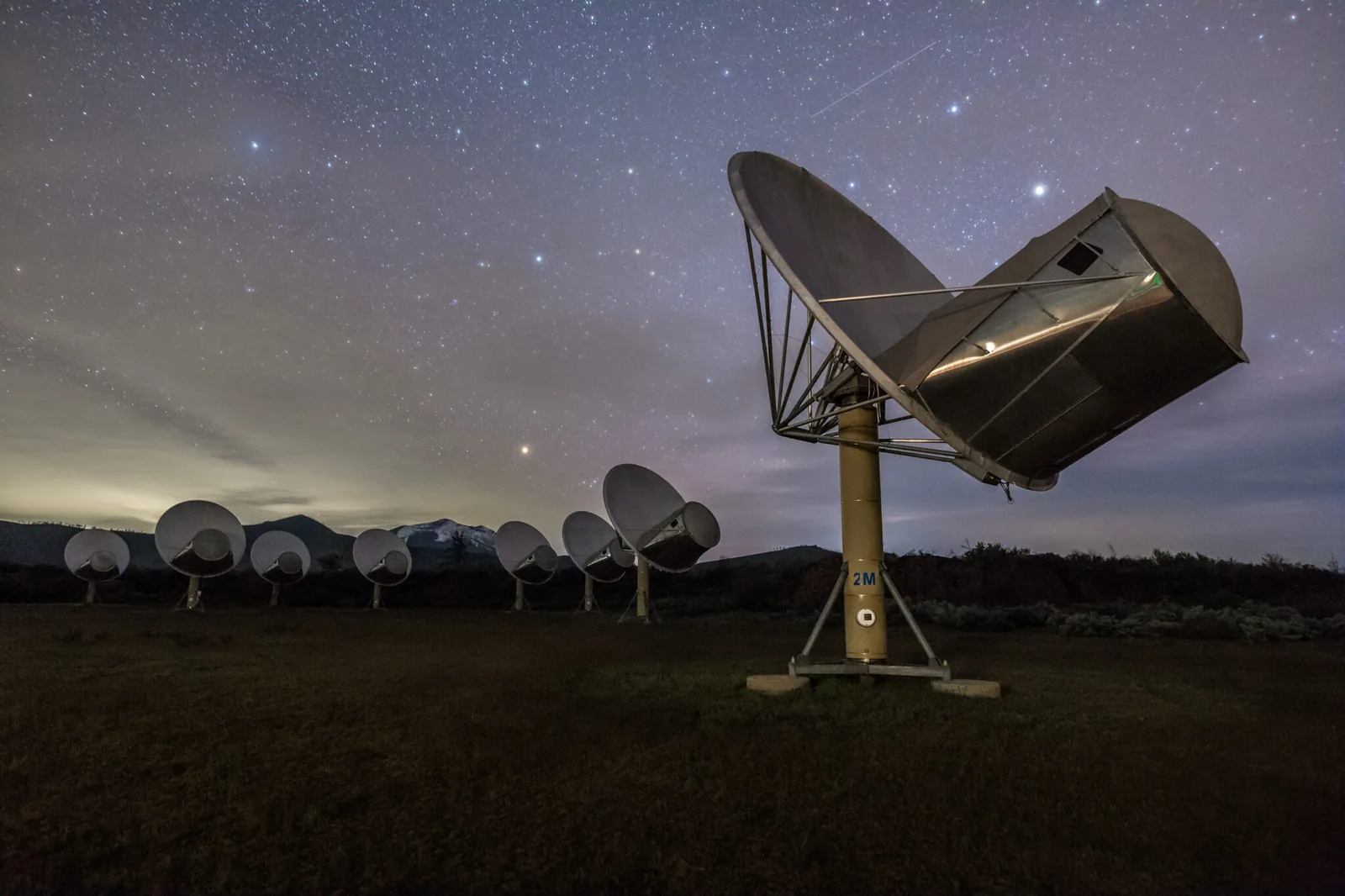
Breakthrough Listen and the SETI Institute have put AI agents to work in the daily search for extraterrestrial intelligence at the Allen Telescope Array in Northern California. The agents steer antennas, correct incoming data and apply AI models to the live stream from a single natural language request. The system handles 2.4 terabits per second on NVIDIA RTX PRO 6000 Blackwell GPUs, with inference running on premises. For business, this matters as a working example of agents controlling physical instruments and high-volume data in real time.
Agents steer antennas and live data pipeline
The deployment centers on the Allen Telescope Array, operated with Breakthrough Listen and the SETI Institute. The NVIDIA Holoscan platform processes massive sensor streams and gives agents live data to act on during observations. DAQIRI, a Holoscan platform library, pulls terabits per second of sensor data directly into GPU memory. That design allows observations to be processed in flight instead of filling hard drives first. Radio telescopes produce volumes that make manual review of interesting signals during observations difficult.
Nexus, a web-based observatory orchestrator, acts as the agent harness for the whole setup. It provides a single source of truth for instrument state, compute resources and pipelines. Researchers can monitor packet loss, read live spectrograms and rewrite signal-processing blocks by prompting in natural language. CyberEther, a signal-processing framework developed at the SETI Institute, performs the math using NVIDIA CUDA-X libraries including cuFFT and cuBLAS. Put together, an agent can point antennae, calibrate and focus the instrument, catch data errors and plot results.
The pipeline has already delivered the first real-time AI detection of a pulsar in the Crab Nebula, a rapidly spinning stellar remnant. The team describes the time effect as compressing work that would take humans weeks or years into hours. Andrew Siemion, Bernard M. Oliver chair for SETI and principal investigator of Breakthrough Listen, framed the shift as a breakthrough in translation rather than something to fear. His point was that new agentic observatories may find signals with more in common with themselves than with humans. Next, the team is evaluating open models including NVIDIA Nemotron for cases where data locality and turnaround matter most.
What agentic observatories mean for business
For companies that operate sensors, instruments or production lines, the practical change is direct control of equipment through natural language tied to live processing. Instead of separate steps for setup, monitoring and analysis, one request can trigger steering, calibration, error correction and visualization. On-premises inference next to the instrument reduces dependence on moving raw data elsewhere before decisions. Small teams gain a way to run complex observation shifts without large specialist crews on site. Large organizations can standardize the same agent harness across multiple facilities and pipelines.
The same architecture carries clear limits that buyers should verify before copying it. Performance at 2.4 terabits per second is tied to a specific stack: Holoscan, DAQIRI, CyberEther, CUDA-X libraries and RTX PRO 6000 Blackwell GPUs. Results from pulsar detection do not by themselves prove reliable detection of unknown extraterrestrial technosignatures. Natural-language rewriting of signal-processing blocks still requires monitoring for packet loss, calibration quality and model errors. Questions to vendors should cover GPU memory capacity, on-premises compute costs, failure handling and how agent actions are logged.
A concrete marker to watch is whether open models such as Nemotron move into routine use where data locality and fast turnaround are critical. A second marker is discussion of observatories running offline on the far side of the moon, which would test fully autonomous operation. If both advance, agentic control of remote instruments will look like a proven operating model. That outcome would carry over to mining, energy, telecom and other sectors with remote high-rate sensors.
