Artificial intelligence now touches nearly every customer service operation, yet most deployments still stop at a single chatbot or an assist panel beside a human agent. Talkdesk research found that 98% of companies have deployed AI somewhere along the customer journey, but only 15% combine agentic AI with cross-departmental orchestration. That gap is becoming the dividing line between companies reporting measurable returns and those still counting deflected calls.
What Talkdesk research shows
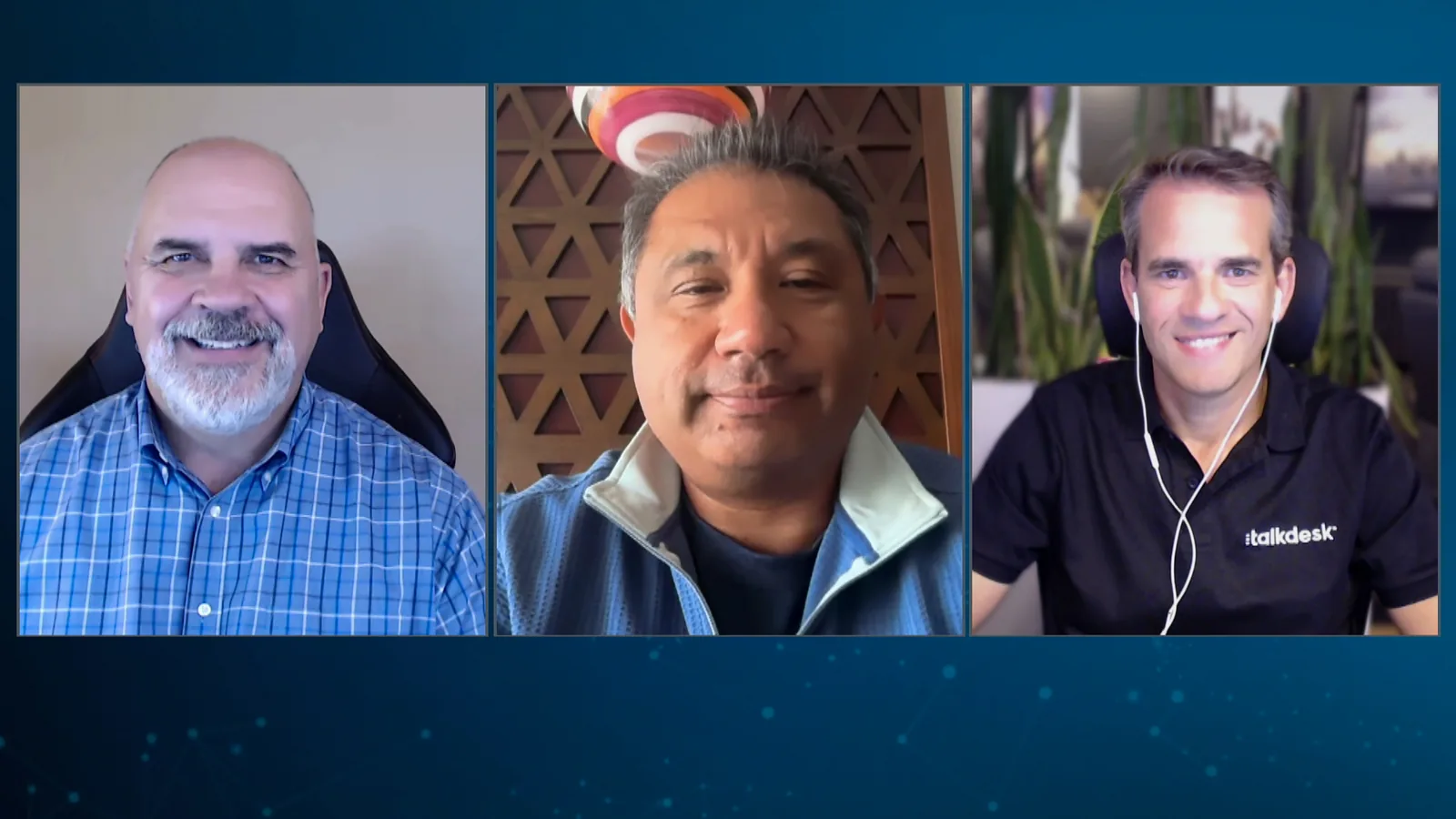
The obstacles sit outside the model itself. Compliance was cited by 50% of respondents, security by 48% and disconnected systems by 45%, according to Pedro Andrade, vice president of AI and generative AI business specialist at Talkdesk Inc. He spoke with theCUBE's Bob Laliberte and Zeus Kerravala at The AI ROI in Contact Center Summit. The difference between leaders and laggards shows up in results: companies Talkdesk classifies as CXA leaders report about four times the net promoter score improvement of less mature adopters — 22% versus 5%. Cost-per-contact gains separate the two groups far less sharply, and churn prediction and personalized recommendations show a similar spread.
Customer experience automation, or CXA, is the premise behind that distinction. Andrade described it as an operating model rather than a product category: the system that coordinates a hybrid workforce of AI and human employees, connecting systems, knowledge and workflows. Agentic orchestration requires AI to maintain context across all those systems, which is why adoption is easy and orchestration is the hardest part. Talkdesk built its CXA Operations Center around the idea that supervisors will evaluate, monitor and course-correct AI agents much as they do human ones, shifting from writing scripts to watching behavior.
The measurement framework shifts with it. Average handle time no longer captures the full process; the relevant metric becomes how much time passes from opening a problem until it gets closed. The end state pushes customer service beyond inbound calls into proactive outreach — service reminders, renewals, collections — because the call is usually the last step of a journey that began somewhere else entirely. Automating one point of failure leaves the underlying process untouched, Andrade said, so companies should map the whole journey on paper and automate it end to end instead of deploying a one-point solution.
What this means for business
For companies that use or adopt AI in customer service, the practical consequence is a change in what counts as a finished project. A chatbot that deflects calls can be launched in weeks, but the returns Talkdesk associates with CXA leaders — the 22% versus 5% NPS improvement — come from connecting knowledge, systems and workflows across departments. That favors organizations able to assign owners for governance and integration, not just tooling. A small company may see faster relative progress because it has fewer disconnected systems to reconcile; a large one faces the 45% figure directly, since legacy systems rarely share context out of the box.
What remains unclear is how quickly the 15% orchestration share can grow. Compliance and security concerns, cited by half and nearly half of respondents respectively, are conditions for any decision, not side issues. This news does not mean that agentic AI is ready to run a contact center without human supervision, nor that cost-per-contact savings prove value on their own — Andrade said savings understate what AI can deliver. Buyers should ask vendors which systems the orchestration layer connects, how context is maintained across them, and how AI agents are monitored and corrected when they drift.
The marker to watch is the share of companies combining agentic AI with cross-departmental orchestration, which currently stands at 15%. If that figure rises in Talkdesk's next research round while the NPS spread between leaders and laggards persists, the operating-model argument will be confirmed by the market rather than by vendor framing. For business, that would mean budgeting for governance and integration work alongside AI licenses, and measuring resolution time from problem opening to closure instead of average handle time alone.