
Stockholm startup 120ft has emerged from stealth with a €576,000 angel round to develop autonomous microfactories staffed by humanoid robots. Its format is three 40-foot containers combining preparation, assembly, inspection and packing under software control. The company will own and operate the facilities while brands pay for finished units, a model that could lower the risk of small-batch production.
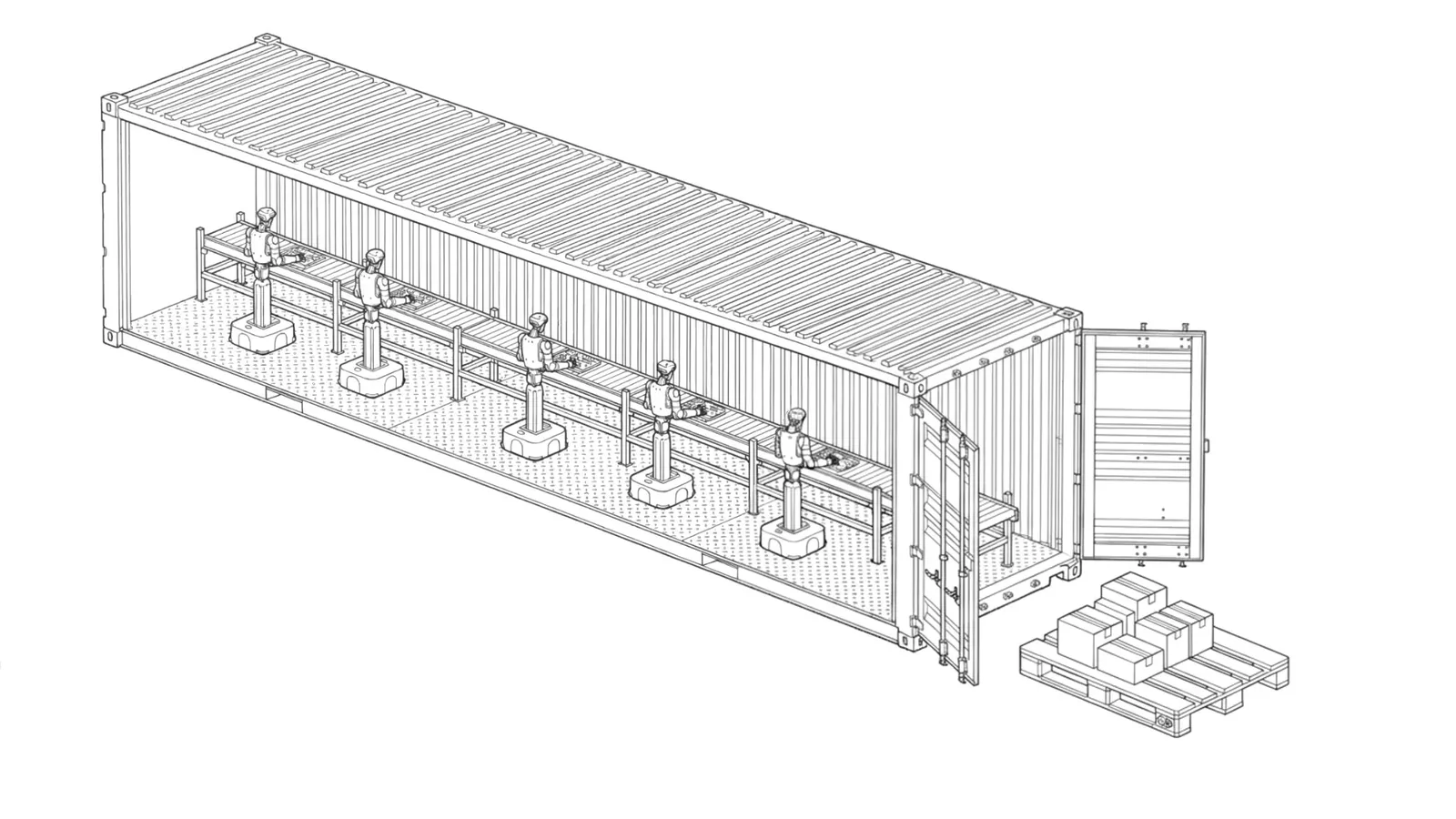
Container format and shared production model
The round includes 22 angel investors, among them Ted Persson, Sophia Bendz, Matthias Dantone and Sam Baker. Founder and CEO Martin Willers established 120ft in 2025 after co-founding repairable audio brand Transparent and building hardware design firm People People, later sold to EY Doberman. Funding will support further development of orchestration software and factory infrastructure on the path toward commercial production.
The proposed operation keeps component supply with the brand and localizes final assembly. Brands send parts to a 120ft site, where the same infrastructure serves multiple customers on a pay-per-unit basis. Initial applications cover small appliances, consumer electronics and other design-led consumer products. That structure avoids purchases of robots or dedicated lines, but leaves international component chains unchanged.
Work begins before physical handling through conversion of designs, parts lists and quality requirements into digital manufacturing instructions. The system then simulates the line to reveal missing data and bottlenecks. During execution, proprietary software coordinates robots, tooling, parts preparation and checks, including recovery from failed tasks. Instructions and production data are retained for reuse in later runs.
What faster skill teaching means for small brands
For smaller consumer brands, shared local capacity addresses large minimum orders, distant assembly and long replenishment cycles. If flexible final assembly cuts the cost of experimentation, companies could test designs and restock without committing to full factory volumes. The benefit will depend on whether savings on batches outweigh local operating expenses for supervision, maintenance and rejected parts.
Several points still need verification before procurement decisions. 120ft has not disclosed simulation platforms or robot models, so the announcement does not confirm integration with tools such as NVIDIA Isaac Sim. The lamp demonstration with cylinder lock, bulb fitting and functional test lacks a testing protocol, success rate and human-intervention frequency. Reported teaching time falling from seven weeks in 2025 to seven hours in 2026, with a seven-minute target for 2027, describes single skills rather than full changeover.
The next marker is sustained output across changing jobs from a containerized system: units per shift, stoppage frequency and true cost per acceptable product. Beyond assembly, 120ft cites repair, upgrades and remanufacturing, where varied product condition adds complexity. Confirmation of stable throughput would show whether reusable software makes small-scale shared assembly commercially viable.
