Zipline launched its First Flight early-access program in Austin on October 9, 2026, opening autonomous drone delivery to the first 5,000 residents who register. Service starts in Round Rock, with expansion across Austin planned over time. Members receive $10 off each of their first three orders and pay no service or delivery fees. For businesses, this matters because a large-scale autonomous delivery channel is now operating in Texas fastest-growing metro area.
How First Flight works in Round Rock
Registration runs through the Zipline app on the App Store and Google Play, where customers create an account and place orders for everyday goods, essentials, family dinner and last-minute items. First Flight members also receive perks including facility tours and a chance to receive official Zipline swag. The company described Austin as Texas fastest-growing metro area and positioned Round Rock as the first service zone. Williamson County Judge Steven Snell linked the choice of Round Rock to the county development into a technology center with an expanding tech footprint.
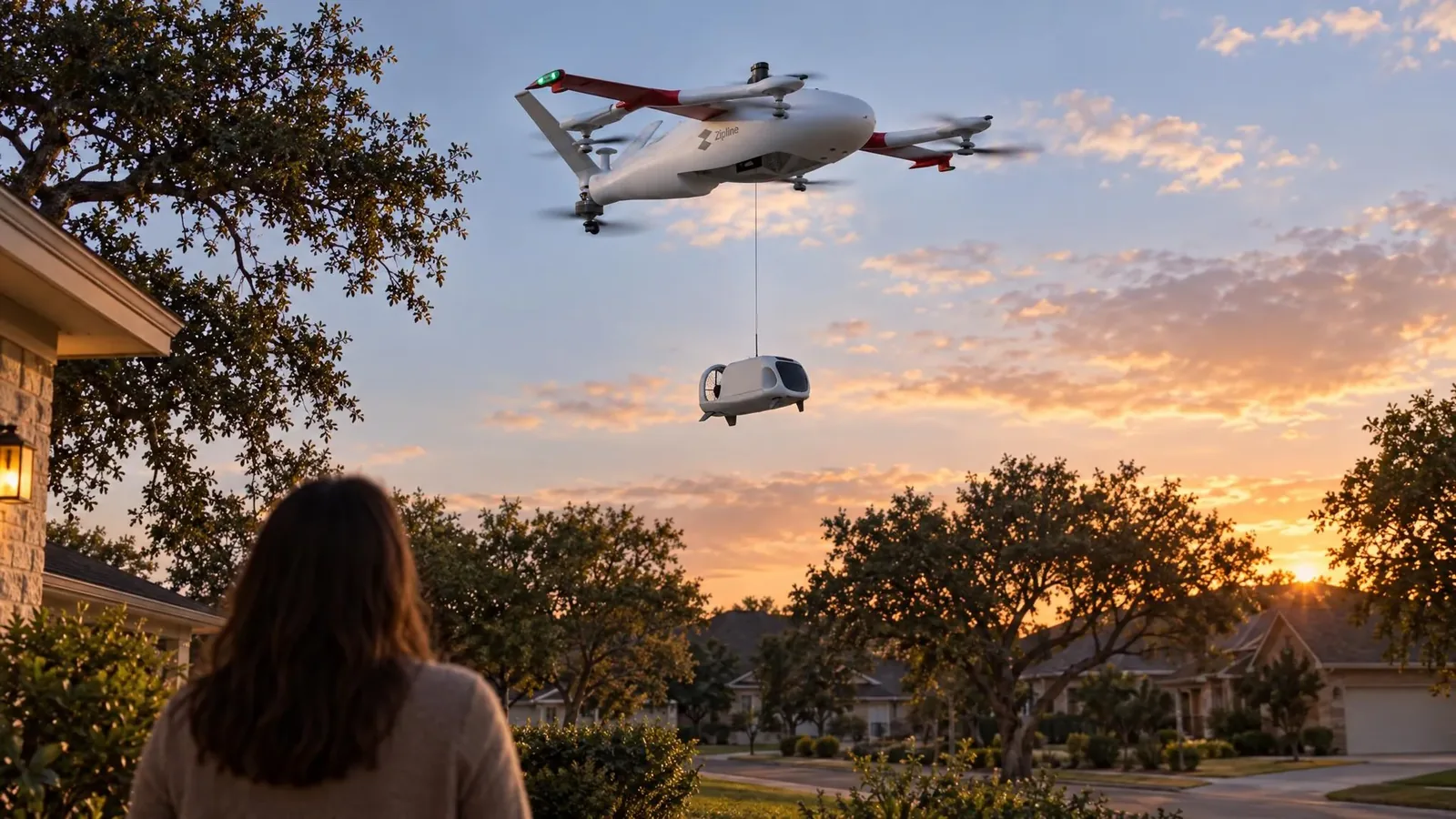
After an order is placed, an electric drone autonomously retrieves it and flies to the customer address. On arrival, the aircraft hovers above 300 feet while a tether lowers a pod with the order to the ground. Zipline said the pod delivers accurately in high winds and poor weather. The aircraft then returns to recharge for its next delivery. The full delivery sequence takes about 90 seconds, which the company said sharply limits how long and how loudly a delivery is heard on the ground.
Zipline bases the system on what it calls a two-part delivery architecture, detailed in an engineering post from March 25, 2026. The aircraft stays high during transit and delivery and takes off and lands vertically using five propellers. The company said it keeps more of each flight in fixed-wing forward flight, where aerodynamic lift from the wings reduces demand on continuous high-power propulsion and lowers decibels. Propellers turn at lower rotational speeds so sound energy concentrates in lower frequencies that dissipate over distance, while uneven blade spacing spreads noise across a broader range instead of a single pitch.
What drone delivery means for local business
For retailers, restaurants and healthcare providers, the program adds a delivery option that does not put additional cars on constrained roads. Zipline cited Austin traffic data showing commutes took 40% longer on average in 2025 than travel without traffic. TomTom reports a 40.5% average congestion level for the Austin metro in 2025, up 1.4 percentage points from 2024, with drivers losing 60 hours to rush-hour traffic. A 10 km drive averaged 14 minutes 49 seconds, rising to 21 minutes 26 seconds in the evening rush at 28 km/h. Small merchants gain access to fast fulfillment without a driver fleet, while larger chains can test drone logistics alongside existing channels.
Scale and noise controls will shape adoption decisions. Zipline said its drones have flown more than 140 million miles and completed more than 3 million deliveries, with operations in more than 30 municipalities in four U. S. states and hundreds of businesses on its app. A software update that cut time in mixed-propulsion transition modes produced a 30% reduction in perceived noise, and the company described its system as six times quieter during delivery than others in the industry. Planned steps include raising typical altitude from at least 300 feet to as much as 400 feet, plus quieter propellers, smarter routing software and rerouting around noise-sensitive areas.
Confirmation will come from expansion beyond the initial cap and zone. The marker to watch is movement from 5,000 members in Round Rock to wider availability throughout Austin, alongside growth in participating businesses and repeat order volume. If flight frequency rises while the altitude increase and routing changes hold, drone delivery will shift from early access to routine local logistics. If coverage stalls, it will remain a limited pilot for selected neighborhoods.