
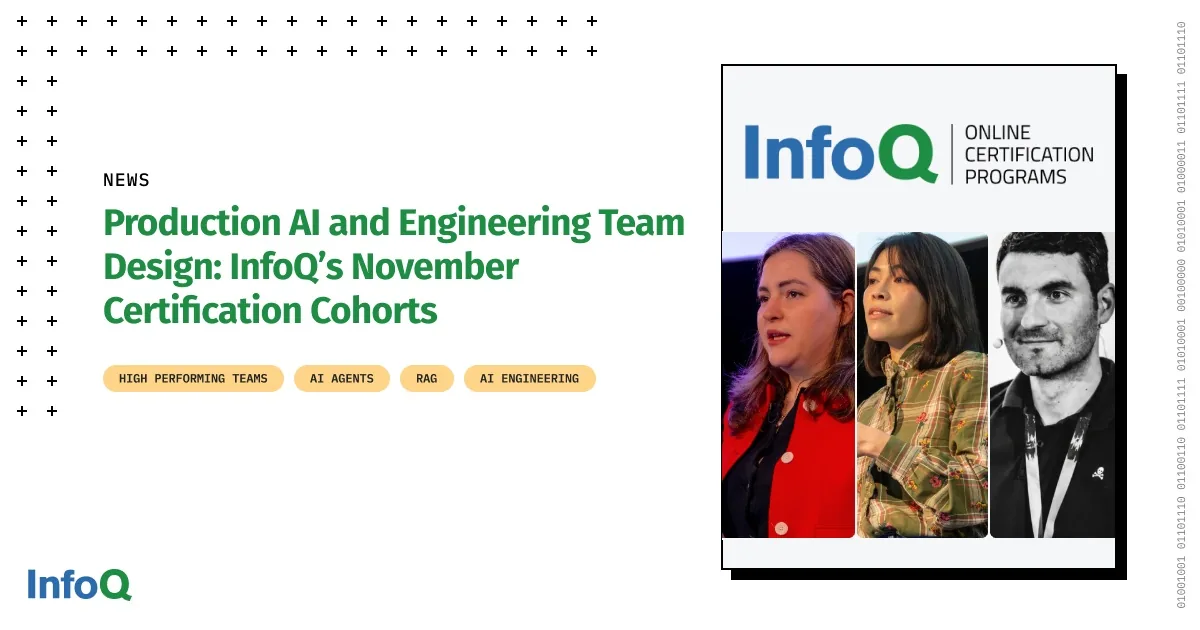
InfoQ has detailed three online certification cohorts starting in November 2026: AI Engineering with Adi Polak on November 12 in PST, AI Engineering with Lan Chu on November 13 in CET, and High-Performing Teams with Olimpiu Pop on November 17. Each program combines live sessions with a capstone, and certification depends on participation and completion of that final work. For companies deploying AI, the offer matters because it links retrieval quality, agent control and team workflow in one learning format.
November dates, facilitators and syllabuses
The two AI Engineering cohorts share a theme but follow facilitator-specific syllabuses rather than identical exercises. Polak, author of Scaling Machine Learning with Spark and a builder of machine learning and real-time streaming pipelines, uses QCon material on context engineering to compare vector retrieval with Graph RAG. Her later weeks cover how agents share state and context, plus orchestration, control, inference gateways and rollout-readiness evaluations.
Lan Chu, a principal engineer with more than seven years building production data and machine learning systems, bases her November 13 cohort on a QCon London case study. That system used retrieval over more than 10,000 documents and served more than 300 people, giving participants a concrete reference for scale. The work includes tracing retrieval and indexing decisions, comparing vector retrieval with Graph RAG, weighing single-agent against multi-agent designs, and selecting production-readiness checks.
The High-Performing Teams program addresses a different constraint: faster code output does not always shorten delivery when review, approvals, infrastructure dependencies or rework become the limit. The November 17 cohort led by Olimpiu Pop, an InfoQ Podcast co-host with 20 years across architecture, engineering management and technology leadership, maps team boundaries, delivery flow and dependencies. Its capstone asks participants to develop and present a target operating model linking responsibilities, delivery flow, AI roles and measurement.
What the format means for AI adopters
For businesses already using retrieval-augmented generation or pilots with agents, the practical value lies in operational evidence rather than model choice. The AI Engineering syllabus treats evaluations, reliability, inference costs, ownership of shared infrastructure and memory pipelines as design decisions. Small firms gain a checklist for rollout readiness, while larger organizations get patterns for gateways, control and verification across teams using common infrastructure.
The format also carries limits that buyers of training should weigh. Cohorts include four live hours per week plus up to two hours of independent work, sessions are not recorded, and groups bring together senior engineers and architects from other companies. Selected capstone work may be considered for InfoQ publication, but publication is not automatic. The news by itself does not prove skill transfer, so ask how attendance is tracked, what counts as successful capstone completion, and how relevant the 10,000-document RAG example is to your own data.
The marker to watch is whether participants publish applied follow-ups after November, showing changed retrieval designs, agent controls or team metrics. Full dates and syllabuses sit on the InfoQ Online Certification Programs site. If those cases appear, the cohorts will have moved from instruction to documented practice that other engineering leaders can reuse.
