
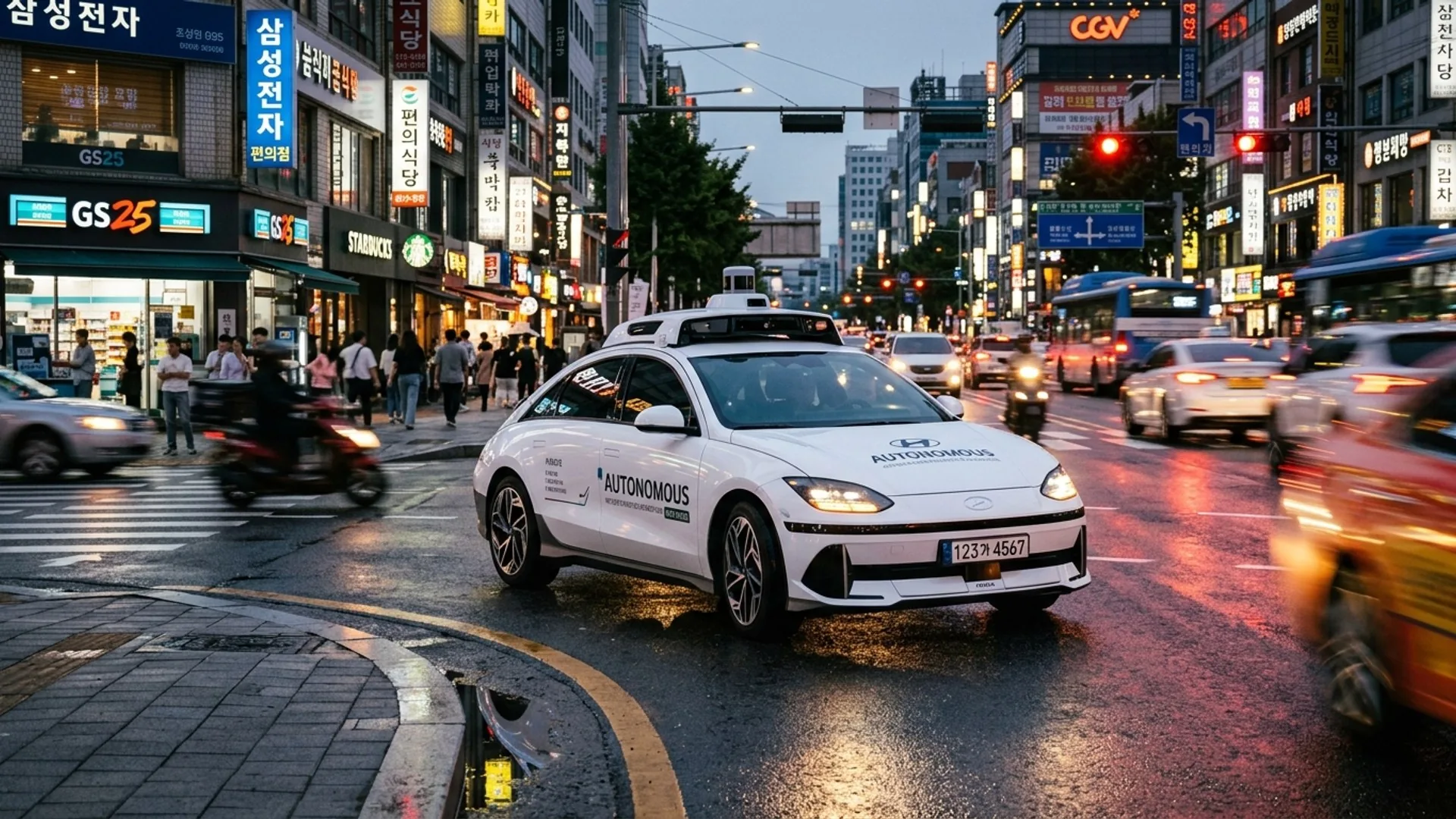
Hyundai Motor Group said on September 13, 2026 that it has put its Data Flywheel into full operation and set out a dual-track autonomous driving roadmap, with Level 2+ production vehicles targeted for the first half of 2028 and Level 2++ vehicles for the second half of 2028. The announcement was made at the HMG Autonomous Driving Media Day at 42dot headquarters in Gyeonggi Province, South Korea, where the Group also showed footage of an Atria AI-equipped SDV Testbed driving through complex urban traffic without driver intervention. The roadmap matters because it ties the Group's autonomous driving plans to a single data cycle rather than to separate model releases.
What happened at the media day
The event covered the Group's autonomous driving strategy, technology roadmap, key achievements and implementation plans. 42dot presented Atria AI, the Group's proprietary autonomous driving artificial intelligence, and outlined a Vision-Language-Action (VLA) technology initiative. Minwoo Park, President and Head of the Advanced Vehicle Platform (AVP) Division at Hyundai Motor Group and CEO of 42dot, said competitiveness is determined by how much data a company secures, how quickly it learns and how effectively it reflects those results in products and services. Junghyun Kwon, Executive Vice President and Head of the Group's Autonomous Driving Development Center and 42dot Autonomous Driving Division Lead, said competitiveness depends less on data volume than on how rapidly data connects to learning, validation and performance improvement. Seonggyun Jeong, Group Lead of 42dot's Atria Group, said Atria AI's performance and maturity are improved through an integrated cycle spanning data collection, model training and real-world vehicle validation.
The Data Flywheel works as a cycle: data collected from vehicles trains and validates AI models, and improved models are deployed back to vehicles, which then generate new data. Hyundai Motor and Kia sell more than 7 million vehicles annually across approximately 190 countries and regions, and the Group currently operates approximately 40 dedicated data collection vehicles around the clock. The collected datasets cover routine driving as well as edge cases: road construction zones and infrastructure variations, severe weather, abrupt lane changes and emergency maneuvers, parked vehicles on side streets and narrow roads, and complex urban traffic dynamics. Since earlier in 2026 the Group has added Hard Example Mining, which identifies difficult driving situations and prioritizes them for training, and a Continuous Training Pipeline that feeds newly acquired real-world data and vehicle evaluation findings back into data collection and model development.
Virtual Validation Technology reconstructs real-world driving data into three-dimensional environments, using graphics techniques such as 3D Gaussian Splatting to recreate scenarios that are difficult or unsafe to reproduce on real roads. A Follow-the-Sun development model connects centers in South Korea and the United States, letting teams use time-zone differences for data collection, issue analysis and model improvement across continuous 24-hour cycles. The Group is gradually integrating its Special Event Recorder, which automatically records and stores significant events during autonomous driving, into the Data Flywheel, mainly to support model training and performance improvement. It is also building a Data Union framework based on standardized sensor architectures and data structures so that data generated across multiple vehicles and organizations accumulates under common standards, initially across Hyundai Motor, Kia, 42dot and Motional.
The roadmap builds on an expanded strategic partnership with NVIDIA announced by Hyundai Motor Company and Kia Corporation on March 16, 2026. That agreement covers autonomous driving development from Level 2 through Level 4 on an integrated architecture built on the NVIDIA DRIVE Hyperion platform, a unified learning pipeline spanning real-world data collection, AI model training and deployment in production vehicles, and further discussions on advancing Level 4 robotaxi capabilities through Motional, the Group's autonomous vehicle joint venture. Under Track One, the Group will integrate NVIDIA's vehicle AI computing platform and autonomous driving software into its software-defined vehicle architecture. Sensor systems used across Hyundai Motor, Kia, 42dot and Motional will be progressively standardized around NVIDIA DRIVE Hyperion 10, a change the Group says will support more consistent data collection and utilization for AI training and validation.
What this means for business
Track Two centers on Atria AI, a proprietary end-to-end autonomous driving system jointly developed by the AVP Division and 42dot under an integrated development framework. Production of Atria AI-powered Level 2++ vehicles is targeted for the second half of 2029, with capabilities progressing in phases based on real-world driving data collected from production vehicles. For companies that buy or operate vehicle fleets, the two tracks mean two different supplier relationships: Track One depends on NVIDIA hardware and software, while Track Two depends on the Group's own stack. A small fleet operator will mostly see the results through driver-assistance features in series vehicles, while a large operator evaluating robotaxi services will need to track Motional and the Level 4 work separately.
Several elements remain unverified. The 2028 and 2029 dates are production targets, not confirmed delivery schedules, and the Group has not published pricing, the list of models that will receive the systems, or the terms on which third parties can access the Data Union framework. The VLA-based autonomous driving technology is currently in the simulation-based model validation stage, with the full development process, including real-vehicle testing, planned from late 2026 through early 2027. The Group also plans, in partnership with South Korea's Ministry of Land, Infrastructure and Transport, to deploy the Atria AI-equipped SDV Pace Car in Jeonnam-Gwangju Special Metropolitan City by the end of 2026, operating on actual Korean roads with complex traffic dynamics and unpredictable variables. Scenarios captured during that deployment will be fed back into the Data Flywheel, enhancing both Level 2+ mass-production driver assistance technology and the validation of advanced Level 4 capabilities.
The marker to watch is the end-2026 Pace Car deployment in Jeonnam-Gwangju. If the Group publishes data on how many scenarios that pilot feeds back into the Data Flywheel and how they change model performance, the cycle can be judged as working rather than announced. For business, that matters because it shows whether autonomous driving timelines are being set by validated data or by marketing calendars.