
Google has opened public access to SynthID Detector, a web-based tool that flags images, video and audio carrying the hidden SynthID watermark. The service recognizes content from AI models by Google, OpenAI, Nvidia and Kakao, with support for Apple tools such as Image Playground expected within weeks. Access requires sign-in with a Google, OpenAI or Apple account, which matters for companies because verification of marketing assets and incoming media now has a free first filter.
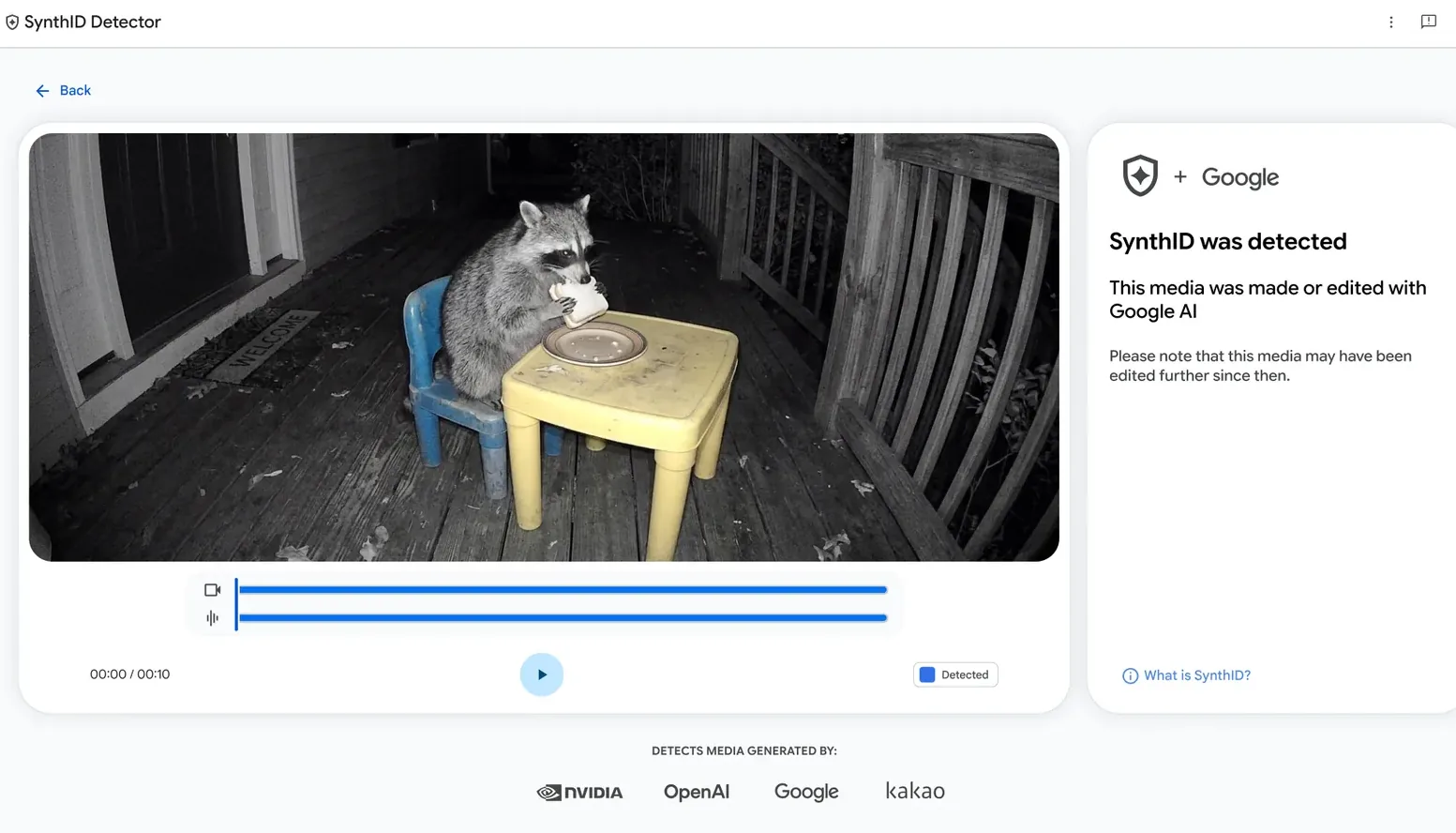
How the public detector works
SynthID itself dates to 2023 as an imperceptible watermark embedded in AI-generated material. Until now, spotting it required special tools with severely restricted availability for journalists and other media professionals. Google also offered indirect checks through its Circle to Search smartphone feature and by uploading files to Gemini with a question about AI origin. The new dedicated detector consolidates this task in one place and makes the capability accessible to a wider audience.
The mechanics are narrow by design: the tool looks for the SynthID marker rather than analyzing visual or acoustic signs of synthesis. That approach keeps detection reliable inside the partner ecosystem, but it defines the boundary of what the service can see. Content must carry the watermark at creation or after AI editing to be flagged. If the marker was never added, the detector has nothing to find, even when the file was produced by a capable generative model.
The launch reflects a fragmented market for provenance. Meta has experimented with its own watermarking and can identify images made with Muse Image, yet that system does not help with third-party models. Anthropic Claude, xAI Grok and many open-weights Chinese models do not use SynthID, so a large share of AI output stays outside coverage. With several watermarking standards in parallel, no single checker can yet serve as a universal arbiter of authenticity.
What this means for business verification
For companies that publish content or accept it from contractors, the detector adds a fast check for assets produced with supported tools from Google, OpenAI, Nvidia, Kakao and soon Apple. Marketing teams can screen stock visuals, agencies can document AI use, and compliance staff can triage suspicious files before deeper review. Small firms gain a no-cost screening step, while larger organizations can insert it at intake points for user-generated material, partner submissions and advertising creatives.
The limits shape how to use the result. The tool does not distinguish material created entirely from scratch from material only edited with AI, and it does not show which part is altered. A negative result does not prove human origin, since Claude, Grok, Chinese open-weights models and Meta-style watermarks fall outside its scope. Decisions on rights, advertising claims or news publication still need source files, metadata review, contracts with suppliers and, where stakes are high, human examination.
A practical marker to watch is whether Google extends partnerships beyond the current group and moves toward shared practice across image, audio and video. The company says it keeps working on new partnerships and favors a layered setup where watermarking, metadata standards and verification tools operate together. If additional large model makers join SynthID or align on interoperable marks, business screening will become more dependable; without that, detection stays partial.