
Robot data startup Mecka raised a $60 million Series B on October 7, 2026, led by Sequoia Capital, to scale its data infrastructure and commercial robot deployments. New backers include NVIDIA, Qualcomm Ventures, Samsung and M12, with Kindred, Framework Ventures and Neo returning. The company said it passed $100 million in run-rate revenue in June 2026 and projects $300 million by year end. For business, the round signals that training data, not hardware alone, now drives robotics value.
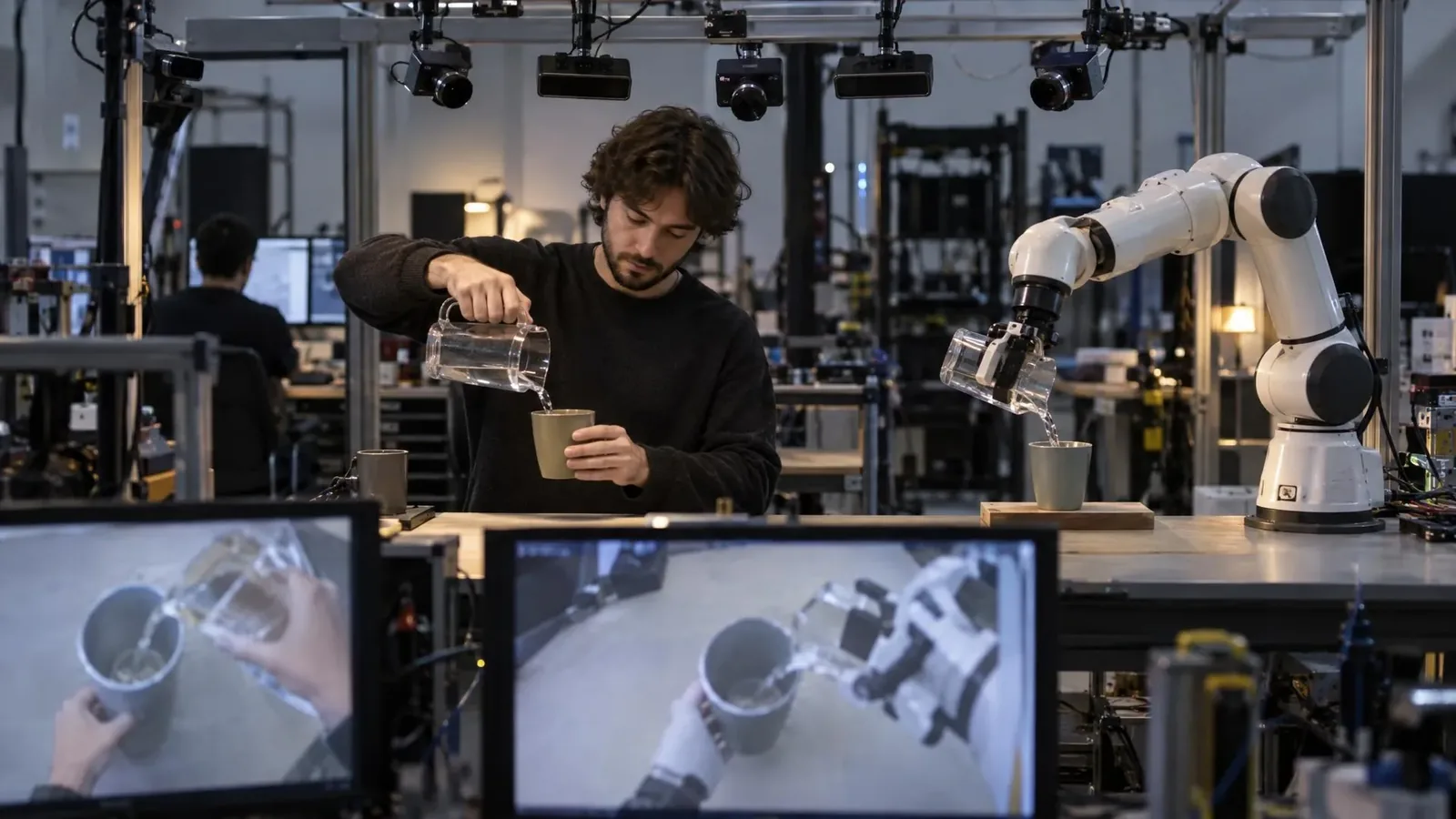
How Mecka captures physical-world data
Mecka positions itself as the data and deployment layer for robotics, supplying several frontier robotics labs and multiple Mag 7 companies. Angel participants include DoorDash CEO Tony Xu, former ServiceNow and Snowflake CEO Frank Slootman, and former Tesla Optimus head Milan Kovac. The capital will expand data production, deepen the internal research lab and build deployment operations. The company is hiring across research, hardware and operations, according to the announcement signed by Josh Gao, Jason Chong and the Mecka team.
The stack starts with proprietary capture hardware designed for each signal class, with sensor choice and synchronization set by downstream model needs. Global capture fleets record human demonstration in homes and commercial environments. An internal lab converts raw activity into structured signal through motion tracking, 3D reconstruction and sensor alignment. The company reports sub-centimeter hand-pose accuracy on in-the-wild data, which it describes as state of the art.
Raw video alone does not train reliable robots because real tasks are noisy and need edge cases and task-specific demonstrations. Mecka lists primitives covering pixel understanding, depth and geometry, object tracking, segmentation, tactile force, sound, speed and motion, point cloud, surface contour and localization. It also offers an iOS app for task-specific capture plus web tools for browsing, visualization, dataset collaboration and inference APIs. Annotation, context, quality assurance and evaluation workflows sit between recording and usable training sets.
What Mecka means for enterprise robotics
The EgoVerse study tested human-to-robot transfer with researchers at Georgia Tech, Stanford, UC San Diego, ETH Zurich, MIT and Meta. Its current release holds 1,362 hours of demonstrations across 80k episodes, 1,965 tasks, 240 scenes and 2,087 demonstrators. The paper, first submitted April 8, 2026 and revised July 7, 2026, found policy performance generally improves with more human data when aligned with robot learning objectives. Mecka describes EgoVerse as its large-scale first-person interaction dataset with standardized formats and manipulation annotations.
For companies without a robotics team, Mecka acts as a modern integrator that brings hardware, capture, post-training, integration and ongoing operations. Unlike a fixed one-time installation, its deployments collect on-site data and post-train to improve with operating hours. The company says it does not build robots but connects hardware, model and commercial ecosystems through the Mecka Loop. Small firms gain access without building data pipelines, while large enterprises can standardize evaluation across sites and workflows.
Several limits deserve attention before signing. Mecka argues motion, contact, force and geometry cannot be scraped or licensed, so buyers should verify coverage for their own tasks, scenes and edge cases. Lab accuracy does not guarantee field performance, since systems must be tested against real workflows and constraints. Ask about data ownership, update cadence, integration scope, and how post-training gains are measured on specific robots and tasks.
The marker to watch is the projected rise from $100 million run-rate revenue in June to $300 million by end of 2026. Hitting that target alongside new instruments and live deployments would confirm demand for bought robot data and deployment services. A shortfall or slow fleet expansion would suggest enterprise adoption remains experimental.