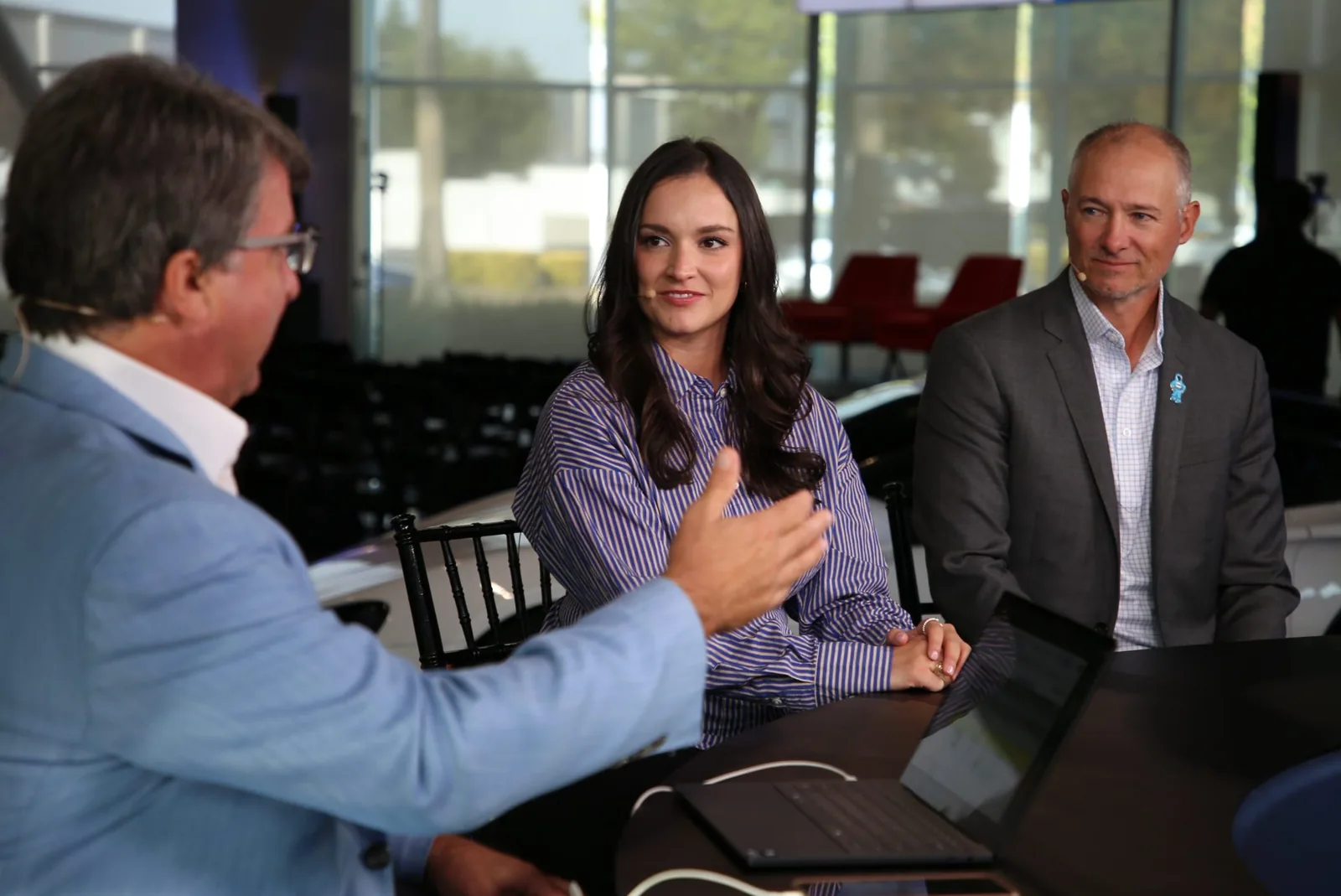
Production, not pilots, now defines enterprise AI. At the Dell Technologies AI Leadership Symposium in San Jose, analysts and vendors said the debate has moved from models and GPUs to who controls AI, where it runs and under whose rules it operates. Dell reported rolling out 350 racks within two weeks through chip partnerships, a signal that deployment speed and operating cost matter more than experimentation.
How production, voice and agents were discussed
Dell Technologies is shifting focus from proofs of concept to production rollouts, supported by an ecosystem that now extends into venture capital. Sean O Connor, regional manager for large enterprise and acquisition at Dell, tied the production advantage to long-standing chip partnerships that enabled 350 racks to ship within two weeks. The message is that rack-scale delivery depends on partners, not only on hardware availability.
Deepgram trains its speech-to-text, text-to-speech and voice agent models on Dell infrastructure, while a large share of its customers host those models themselves. Nick Mann, staff technical program manager at Deepgram, said the next step is running the models natively and air-gapped on AI-enabled laptops. The design puts voice processing where people work, without a permanent connection to a data center.
Runtime governance emerged as the condition for enterprise AI agents. Victor Jakubiuk of MisaLabs, Shiv Agarwal of Singulr AI and Sri Viswanath of Sycamore Labs said enterprises want agents kept inside their own virtual private clouds. Oversight is moving from fixed rules to monitoring agent behavior at runtime, a response to always-on autonomous agents. Sycamore Labs is among startups raising money to build governance layers for agents.
What this means for enterprise AI budgets
Token spending is changing where workloads run. Helen O Sullivan of Dell and Tim Wood of Intel said customers burning through months of token budgets in weeks are testing workloads on-premises. Keeping data and AI close together, including on AI PCs, reduces those recurring charges. For companies using AI, the practical effect is a wider choice between public APIs and self-hosted inference.
The CPU is returning to agentic AI architectures. Dell and Intel linked that shift to agents that coordinate tools, retrieve data and run for long periods rather than performing single large training runs. Small firms may feel it through AI PCs and hosted models they can operate themselves, while large firms face rack planning, private-cloud controls and closer coordination with chip suppliers. Vendor selection now includes delivery timelines and ecosystem support.
The marker to watch is whether on-premises tests turn into permanent moves. If more voice and agent workloads stay in private clouds, on local servers or on air-gapped laptops after token-budget overruns, cost and control will have set the next deployment standard. TheCUBE, a paid media partner for the event, said full interviews from the symposium will follow, which should show which projects passed that threshold.