
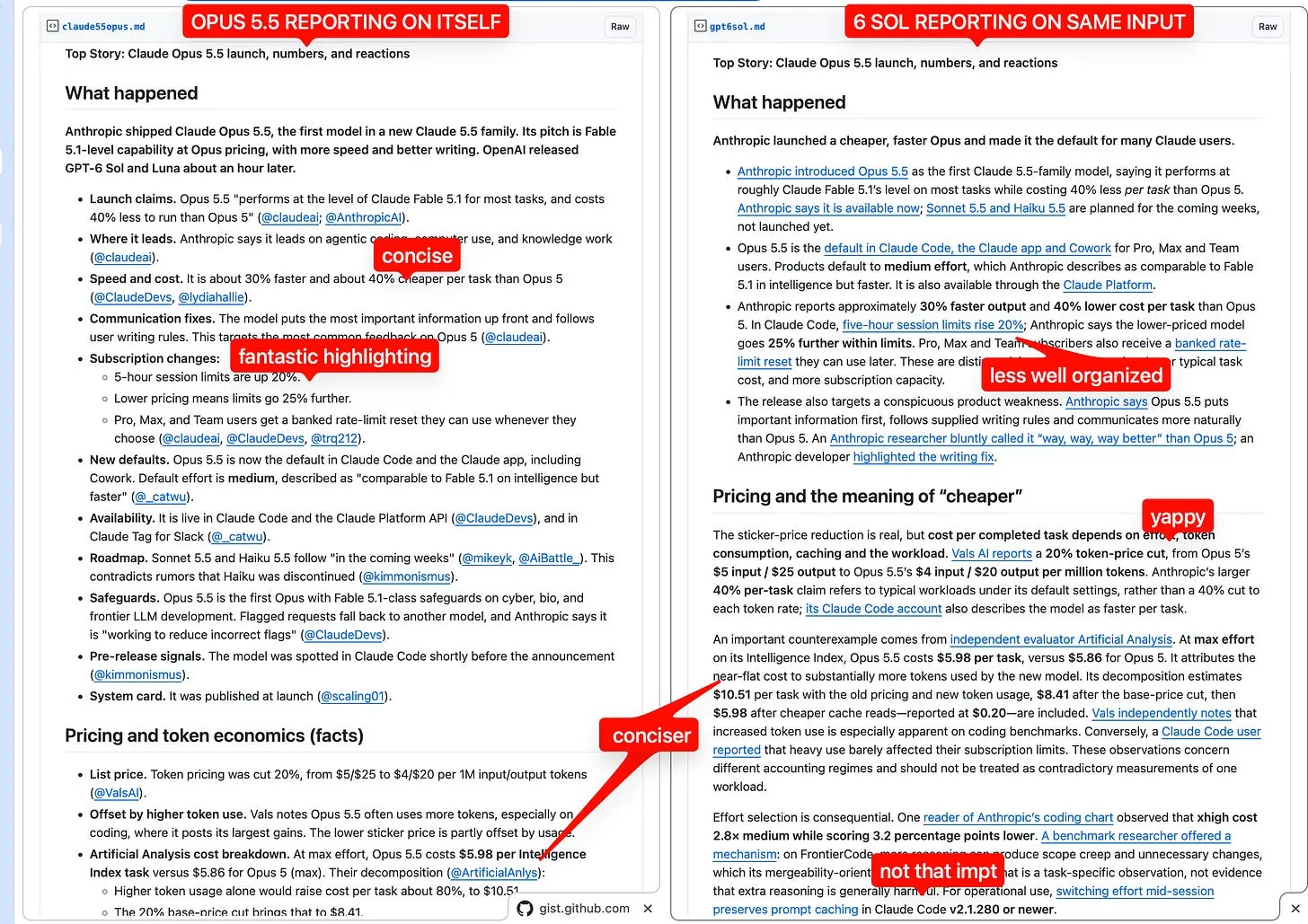
Anthropic released Claude Opus 5.5, the first model in the new Claude 5.5 family, which performs at the level of Claude Fable 5.1 on most tasks and costs 40% less to run than Opus 5. The editorial team of AINews, a section of Latent Space, announced an immediate migration to Opus 5.5 after comparing its output with GPT-6 Sol. This matters because the model instantly became the default in Claude Code and the Claude app, including Cowork, so the change reaches working teams without any configuration.
What changed in the new model and its pricing
The list price for tokens was cut by 20%, from $5/$25 to $4/$20 per 1M input/output tokens, and per-task cost fell about 40% against Opus 5 with roughly 30% more speed. Anthropic reports leads in agentic coding, computer use, and knowledge work, and its own comparison table shows Opus 5.5 ahead of Fable 5.1 on every row and ahead of GPT-6 Astra on most. On CursorBench the model scores 57.8% at Max effort and becomes the top result while costing 40% less per task than Opus 5; on FrontierCode 1.1 it reaches 65.3% on Extended and takes first place from Fable 5. Sonnet 5.5 and Haiku 5.5 are promised in the coming weeks, which contradicts earlier rumors that Haiku had been discontinued.
Under the hood the gains come from efficiency work across prefill, decode, and overall compute, which both Anthropic and OpenAI credited for their own price cuts after GPT-6 Sol and Luna launched 50% below GPT-5.6. Artificial Analysis breaks down the real economics: at max effort Opus 5.5 costs $5.98 per Intelligence Index task against $5.86 for Opus 5, because higher token usage alone would raise cost per task by about 80% to $10.51, offset only by cheaper cache reads at $0.20. The advertised 40% saving therefore holds at the default medium effort, while the per-task advantage disappears at max. Cline reports Opus 5.5 beating Fable 5.1 on the Intelligence Index at roughly 2.5x lower cost, and prompt caching survives effort switches in Claude Code v2.1.280 and later.
The launch lands against a crowded backdrop: OpenAI shipped GPT-6 Sol and Luna about an hour later with 50% lower pricing than GPT-5.6, and both labs tied their price reductions to efficiency gains. Anthropic also published its system card on day one, including Section 8.12 on scaling to 100 parallel agents, described by commentators as the first lab report of its kind. Safeguards reach Fable 5.1 class on cyber, bio, and frontier LLM development, with flagged requests falling back to another model. Sam Bowman of Anthropic stated that releasing Opus 5.5 more likely than not reduces misalignment risks, while Mike Krieger pointed to extensive alignment testing including outside evaluation by METR.
What this means for teams adopting AI
For companies running agents in production, the immediate effect is a lower bill at unchanged quality: the default medium effort delivers Fable 5.1-level intelligence at roughly 40% lower per-task cost, and the 20% cut on token list prices applies to every request. Small teams benefit most because they rarely tune effort settings and will sit on the default, while large organizations with heavy coding workloads should model savings against actual token consumption, since Vals notes Opus 5.5 often uses more tokens precisely where its gains are largest. The model also puts key information first and follows user writing rules, which directly addresses the most common complaint about Opus 5 in long sessions.
Several caveats need checking before a vendor switch. At max effort the per-task saving over Opus 5 vanishes, and an agentic coding chart shows xhigh effort costing about 2.8x more than medium for a 3.2-point lower score, so effort level should be pinned deliberately. ProgramBench results near 100% come from a 166/200 subset that likely excludes the hardest programs such as FFmpeg and the PHP compiler, with partial solves passing 60-70% of tests inflating the pass rate. ParseBench still shows weakness on charts and layout, and at 5.8 cents per page LlamaIndex calls the model too expensive for production OCR, a verdict from a vendor with a competing product. Over-triggering of safety classifiers remains a live issue: one user was downgraded to the fallback model after a benign request, and Anthropic says it is working to reduce incorrect flags.
The clearest marker to watch is the rollout of Sonnet 5.5 and Haiku 5.5 in the coming weeks: if the cheaper tiers land with the same efficiency profile, the price reduction extends across the whole Claude line and changes vendor shortlists for agent projects. If instead savings hold only at medium effort while max-effort costs stay flat, procurement should treat the 40% figure as a default-settings claim rather than a budget line.