
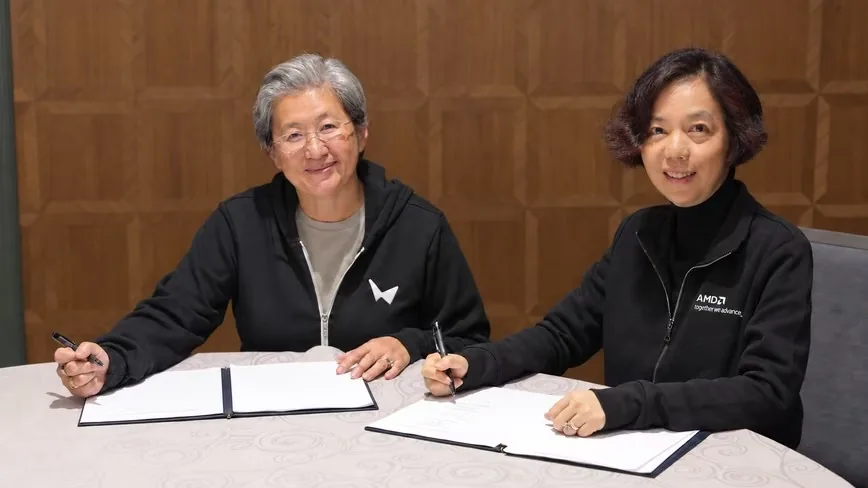
AMD agreed to acquire World Labs, the AI model startup led by Fei-Fei Li, in an all-stock deal valued at about $8.2bn. The deal was announced on Monday, with Li set to join AMD as executive vice president and chief scientist reporting to CEO Lisa Su. The move gives AMD direct control over a leading spatial intelligence team at a moment when AI workloads shift toward robotics and simulation.
Deal terms and World Labs technology
AMD expects the transaction to close by the end of 2026, subject to regulatory approvals. After closing, the World Labs team will continue AI model research inside AMD, while co-founders Justin Johnson and Ben Mildenhall will keep leading that work together with Li. The San Francisco startup was founded at the start of 2024 and raised $1bn in February from investors including AMD, Nvidia, Autodesk, Emerson Collective, Fidelity and Sea.
World Labs builds spatial intelligence models that generate, rebuild and simulate interactive 3D environments from text, images and video, plus technology for robot learning and simulation. Its product Marble creates 3D worlds from images, video or text, while its newest model Atlas predicts new camera views from 2D images. Li described the logic of the combination in blunt terms, saying that without a focused hardware effort AI remains constrained in efficiency and scale.
Li brings a research record that shaped modern computer vision, including early work that produced the ImageNet dataset and the role of founding director of Stanford Human-Centered AI institute. She said Su was an early investor in World Labs, and the two companies started a technical partnership last year around model training and inference on AMD GPUs. Other companies are also building world models, systems that learn how the physical world works, so AMD is buying into an active competitive field rather than an empty niche.
What the acquisition means for AI buyers
For companies deploying AI, the deal signals where AMD plans to aim its future compute platforms: reasoning, robotics, simulation and physical AI. AMD said World Labs model expertise will show how AI workloads are changing and help shape its technology roadmaps, with Su adding that next-generation platforms require deep understanding of model evolution. In practical terms, buyers working with 3D content, digital twins or robot simulation could see better-tuned AMD hardware and software stacks over time.
Small firms are unlikely to feel an immediate effect, since the transaction will not close before the end of 2026 and integration takes additional time. Large enterprises already testing simulation, robotics pilots or synthetic data generation have more reason to track the roadmap, especially if they run training and inference on AMD GPUs. The context matters too: in August AMD bought Taalas, a startup that etches AI models into silicon, and in July it committed to invest $5bn in Anthropic, which points to a broader push across models, chips and partnerships.
The marker to watch is regulatory clearance and closing by the end of 2026, followed by concrete roadmap changes that reference spatial and world-model workloads. If AMD starts disclosing performance, tooling or partnerships tied to Marble, Atlas or robot simulation, the thesis behind the $8.2bn price will be taking shape. Absence of such signals after closing would suggest the research team remains isolated from product decisions.