
Space No Longer Waits for Commands from Earth
I always thought space was a territory of total control. Every maneuver was calculated on Earth, and the spacecraft just executed commands. But that model is cracking. NASA, IBM, Anthropic, and private startups are testing generative AI right in orbit and on Mars, so satellites, robots, and rovers can understand their surroundings and make decisions on their own.
Not long ago, trusting a spacecraft to a non-deterministic system seemed like heresy. But missions are getting more complex, farther away, and more numerous, and communication delays make manual control impossible. The question is no longer whether we can trust AI in space. The question is whether we can do without it.
Last December, JPL used Claude models from Anthropic to plan two trips for the Perseverance rover. The algorithm proposed a route, and human planners checked and adjusted it. In May, NASA and IBM put a compressed AI model on the ISS and a satellite, where it identifies floods and clouds right in orbit. In July, astronauts tested a large language model as a maintenance assistant on the station.
Why Predictability Doesn't Work Anymore
For space engineering, this is a cultural shift. For decades, spacecraft flew autonomously only partially, and the dominant philosophy was predictability: the machine does exactly what developers programmed. Robert Ambrose, former head of NASA's Software, Robotics, and Simulation Division, says plainly that engineers hate autonomy because of its unpredictability.
The problem is that an autonomous system can reach the same situation through different paths—and behave differently. How do you test all scenarios when their number grows exponentially? Ambrose spent most of his career on this, including autonomy for Orion and the Robonaut 2 robot.
With Orion, the team faced an avalanche of tests: they had to account not just for what the ship could do, but for all the decision chains that led there. The solution, according to Ambrose, was paradoxical—they automated testing itself using autonomy. As he jokes, they fought the complexity of autonomy with autonomy itself, and it worked.
The farther from Earth, the more obvious the need for real independence. Ambrose gives the example of a mission to Europa: the spacecraft would have to dive through a water plume erupting from under the ice crust. Such an eruption can appear and vanish faster than Earth commands can react with an hour's delay. The ship decides on its own, and engineers learn about it an hour later. Without real autonomy, such a mission is simply impossible.
Robots That Relearn Zero-G Physics from Scratch
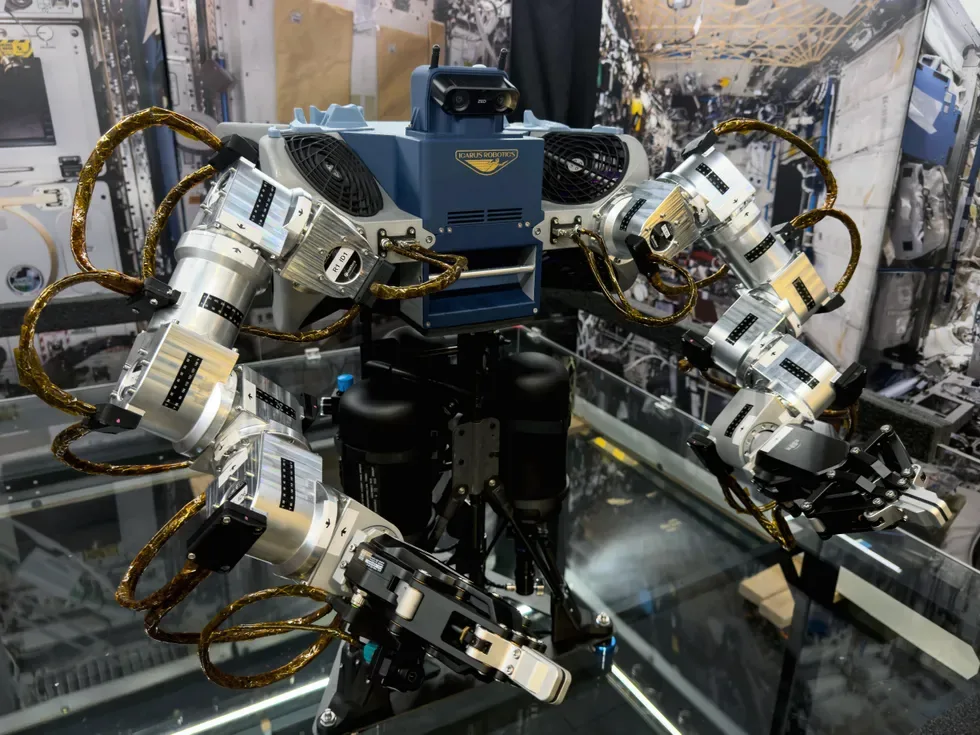
While agencies think about deep space, the commercial boom is opening the door to robotics in low orbit. But what works on Earth breaks immediately in zero gravity. Startup Icarus Robotics is building what it calls a robotic workforce for space, including a free-flying system called Joy.
Joy recently underwent zero-g tests in Canada during parabolic flights and is preparing for the ISS, where one of its first tasks will be moving cargo bags between modules. The company plans to start with human teleoperation to collect data and gradually train robots to act independently. According to co-founder and CTO Jamie Palmer, deployment will move through partial autonomy, with a human operator always in the loop.
The problem is physics. A robot trained on Earth learns that a pushed object falls down. In orbit, it just keeps flying. So, as Palmer notes, if you take the latest Gemini robotics model and drop it into zero-g, it fails instantly. The industry has the same data problem as ground robotics, only in extreme form.
Co-founder and CEO Ethan Barajas admits he'd be happy to just download a ready-made microgravity dataset, but no meaningful one exists. So Icarus combines microgravity demonstrations with simulations and ground tests, building its dataset from scratch. Company engineers literally fly in zero gravity to collect valuable training data.
Managing Risk Instead of Dreaming of Zero Errors
Teaching a spacecraft to act independently is only half the task. The other half is managing the risks of greater freedom. Ufuk Topcu, a professor of engineering at UT Austin and director of the Center for Autonomy, is surprised at how little autonomy is still used in space. After all, that's exactly where human involvement is hardest, stakes are high, and action is needed fast.
According to Topcu, the goal can't be guaranteeing that autonomous systems never make mistakes. Their main value shows up precisely in situations people can't foresee. So the strategy should be different: start with limited applications, study system behavior, then gradually expand their responsibility. The question isn't whether risk can be fully eliminated, but how well it's managed during deployment.
This approach becomes critical as the whole industry transforms. For most of the space age, a small number of government agencies designed missions over decades. Now commercial companies are putting more and more spacecraft into orbit, and new missions are created and launched much faster. As Topcu notes, the innovation cycle used to take 10–15 years from concept to flight, and today everything evolves rapidly.
What It Means for Us
For businesses and ordinary people, this means the entire space economy accelerates: from real-time satellite monitoring of floods and fires to orbital warehouses and factories serviced by robots. The experience with autonomy in space transfers directly to Earth—into AI agents, warehouse robots, and automation systems where you also have to balance control and independence. And if companies want to use the same logic of gradual autonomy for routine operations today, integrating an AI agent into your business from the AIXVZ team can help.