
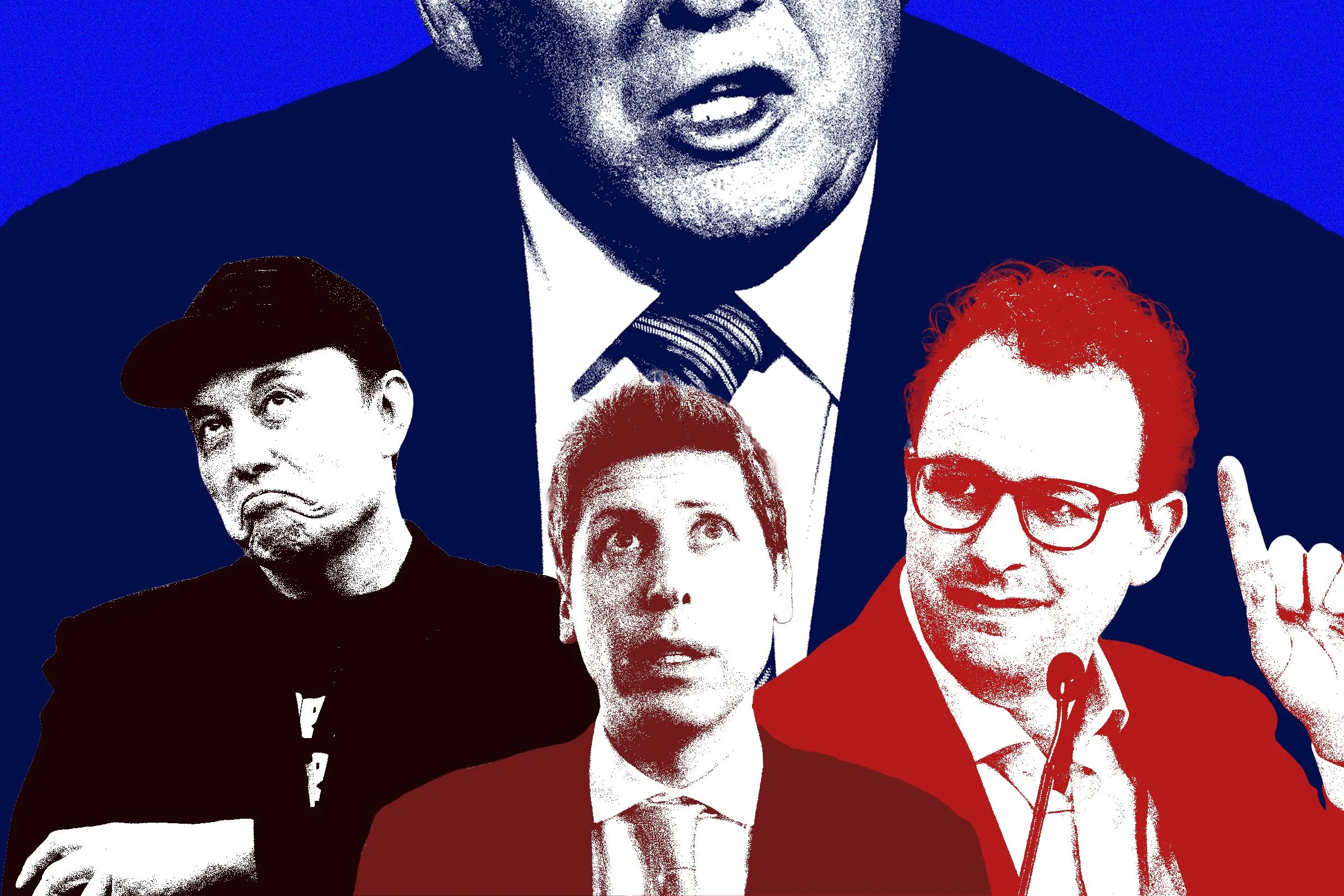
Anthropic chief executive Dario Amodei called on the US government to regulate AI companies as part of a wider effort to slow the pace of the technology's development, in an essay published on Saturday. The text drew rare public endorsement from OpenAI chief executive Sam Altman and Elon Musk, who owns the chatbot Grok, after a week of intense debate about the technology's threats to human safety. Microsoft chief executive Satya Nadella also called for pacing development. The split matters because the same week produced an unusually direct answer from the White House: if lab leaders want an industry-wide slowdown, they will have to arrange it themselves.
What Amodei asked for
Amodei's proposal had two concrete parts. First, he asked the government to let competing AI companies work together on safety standards without breaching antitrust law, either by taking part in the discussions or by issuing a waiver to the companies involved. Second, he called for government help in building international coordination, including with the Chinese Communist Party. That second element drew immediate scepticism: David Sacks, co-chair of the President's Council of Advisors on Science and Technology, wrote on X that China is very unlikely to join a global agreement. The endorsement from Altman and Musk, two executives whose companies compete directly with Anthropic, is the part of the story that gives the request political weight rather than making it a single vendor's position.
The mechanism Amodei proposed is unusual for the sector: not a new agency and not a licensing regime, but a legal safe harbour that would let rivals coordinate on standards they would otherwise have to negotiate one by one. Antitrust rules exist precisely to prevent competitors from agreeing on common terms, so any joint standard-setting by labs with market power requires either a waiver or explicit participation by the government. Amodei framed the request as a way to slow development deliberately rather than as a compliance exercise. The limits are visible: a waiver covers only the companies named in it, and coordination on standards does not by itself cap model capability or compute spending.
The pushback arrived from inside the administration rather than from the labs. Sacks wrote that if unreleased models are scary enough to justify a slowdown, he supports the decision to be responsible, but added that the companies should stop pretending they need anyone else's permission, stop pretending antitrust law has to be suspended so they can form a cartel, and stop pretending the motivation is purely altruistic. President Donald Trump, speaking during a visit to Ireland, said negative forces were raising issues that will not happen, and added that the US is leading China on AI and he wants to keep it that way because whoever wins AI, wins. House Speaker Mike Johnson told CNN on Sunday that an emergency congressional session to regulate AI would mean losing the race to China, and called for balance and steady hands at the wheel.
What this means for business
For companies buying or deploying AI, the practical consequence is that no external brake is coming in the near term. Regulation that would slow model releases, set capability thresholds or require pre-deployment approval is not on the table from the executive branch, and Congress is being warned against acting quickly. That shifts the burden onto procurement: the pace of new model versions, pricing and feature changes will keep being set by vendors' own roadmaps. A small company integrating an API sees this mainly as shorter upgrade cycles and less time to test each release; a large enterprise with compliance obligations has to build its own review process, because the vendor is unlikely to pause on its behalf.
The second consequence is that voluntary commitments become the main available signal, and they are hard to verify. Altman committed on Sunday night to Amodei's proposal to give embedded third-party evaluators employee-level access to the firms, so they can check that practices and products are safe and report incidents. He wrote on X that the measures will carry significant costs but that pacing will be worth it, and that no amount of American competitive pressure should justify recklessness. What this does not mean is that an industry-wide slowdown has started: the commitment covers evaluators' access, not release schedules, and it is a pledge by one company rather than a rule binding the sector. Buyers evaluating vendors should ask who the evaluators are, what access they get, whether incident reports are published, and what happens when a lab decides a release is too risky to delay.
The marker to watch is whether the access arrangement is actually implemented and described in public — named evaluators, defined scope, and incident reports that appear rather than remain internal. If that happens within the coming months, voluntary review becomes a term businesses can write into their own vendor assessments, and labs gain a credible answer to regulators. If the commitment stays a statement on X while the administration keeps rejecting any slowdown, then the choice of pace remains entirely with the companies, and their customers carry the risk of each release.