At the AGNTCon + MCPCon Europe 2026 conference in Amsterdam, the dominant theme was not the threat of runaway artificial intelligence but the business use of AI agents. None of the frontier model vendors appeared on the show floor, while the startups that did exhibit focused on governance, orchestration and control of agentic systems. The absence of the largest model developers is itself a signal: the practical agenda has shifted from model capability to managing what agents do inside a company.
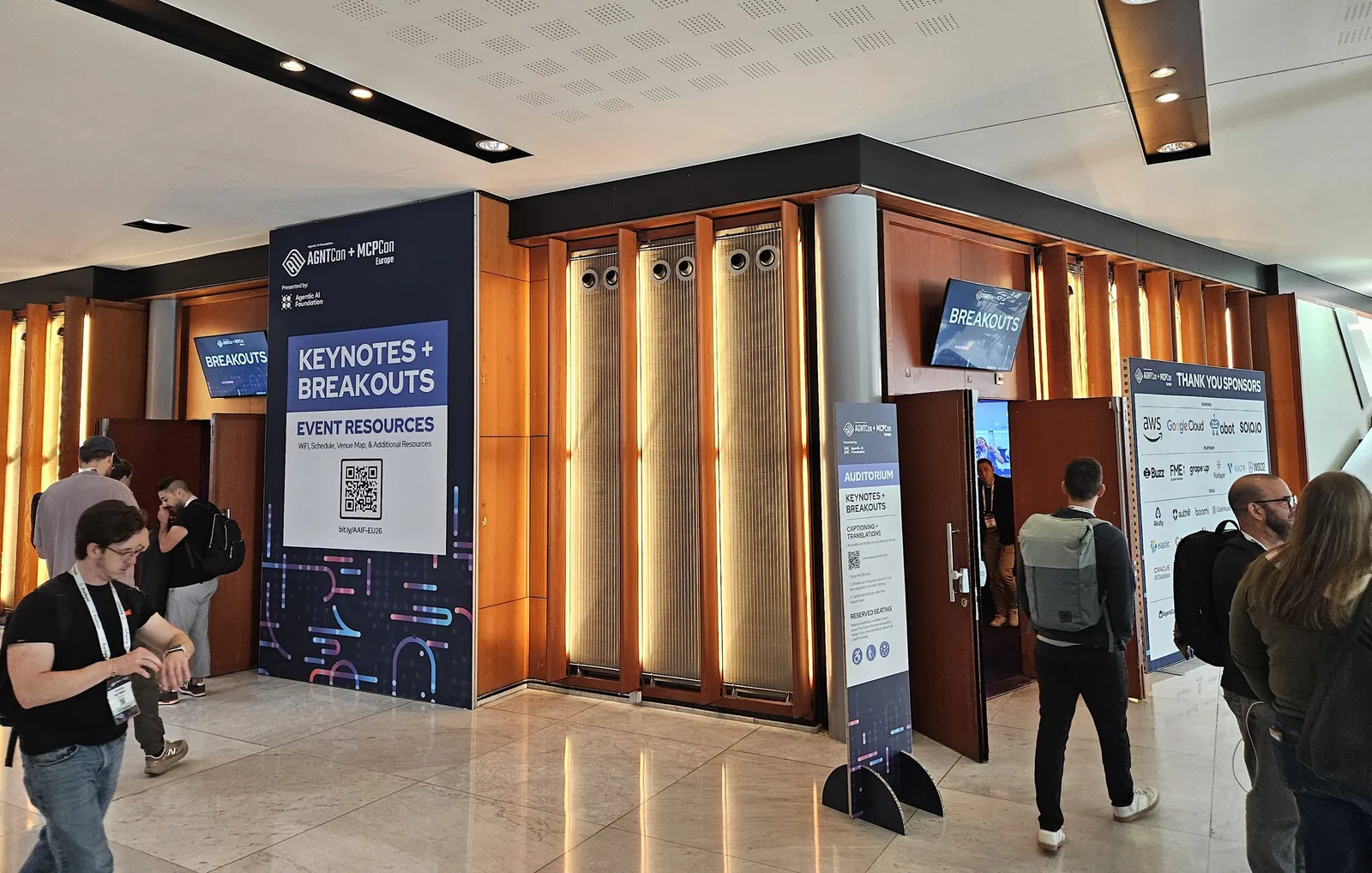
What happened at AGNTCon Europe 2026
Jason Bloomberg, founder and managing director of Intellyx, spoke with most exhibitors and selected seven companies as representative of the balance between customer traction and rapid innovation. The list spans risk management, agentic orchestration and language model plugins. Traefik Labs SAS, Bluerock Security Inc., Orkes Inc., Grape Up Sp. Z o. o., Manufact Inc., Alpic SAS and Reboot Inc. each presented a different layer of the emerging stack. The conference took place in Amsterdam; a North American edition, AGNTCon + MCPCon North America, is scheduled for San Jose, California, on Oct. 22-32, where many of the same vendors will appear.
The common thread across the seven vendors is that control mechanisms are being built into the products rather than added afterward. Traefik Labs combines an application programming interface, AI and Model Context Protocol gateway into a single binary, monitoring every way an agent interacts with its environment to produce what the company calls a sovereign trust plane. Bluerock Security, which previously built a military-grade microkernel hypervisor for data isolation on bare metal, now offers a governed AI workspace that limits access to models, manages token usage and connects to enterprise identity systems. Its agentic code scanning extends static application security testing to MCP servers and agent skills. Orkes, born out of Netflix Inc., brings deterministic orchestration with explainability, so operators can inspect and track agentic interactions. Grape Up's Aiboostr platform maintains a catalog of AI capabilities and tracks each agent's owner, purpose and users to comply with the EU Artificial Intelligence Act.
Two vendors addressed a newer layer: LLM plugins. These are distributable workflow packages that use MCP and can contain reusable skills and apps, connecting to external data and actions. Manufact Inc. runs a cloud-based MCP platform where developers build and run components that agents interact with, including plugins, with analytics, testing and compliance for production deployment. Alpic SAS applies plugins to business-to-consumer use cases: a consumer asking ChatGPT for a travel itinerary with specific requirements, such as a hotel room with a king-size bed, can receive a functional mini-application that both answers the request and completes the reservation. The mechanism resembles the portlets that portal vendors offered more than 20 years ago, except users now find them through an AI chat interface.
What this means for business
For companies adopting AI agents, the practical consequence is that governance and orchestration are becoming purchasable products rather than internal projects. A small company can now buy a governed workspace or an MCP gateway instead of building access controls and audit trails from scratch, which lowers the entry barrier for putting agents into production. A large organization gets a different benefit: the ability to keep an inventory of AI capabilities and to prove to auditors and regulators who owns each agent and what it is allowed to do. The EU Artificial Intelligence Act makes that inventory a requirement, so the catalog functions in Aiboostr and the evidence trail in Traefik's trust plane address a compliance need, not a hypothetical one.
What the conference does not settle is how mature these products are. The market is nascent, innovation produces new business models weekly, and Bloomberg notes it is sometimes hard to tell real products from hand-waving. Before choosing a vendor, a business should ask which agents the platform actually controls, whether it integrates with the existing identity management system, what evidence it produces for an audit, and how it handles token usage and cost. The presence of paying customer stories at the show is a positive signal, but it does not by itself confirm that a given tool will work inside a specific company's stack. The absence of frontier model vendors from the floor also means the governance layer is being defined by smaller players whose long-term support is not guaranteed.
The clearest marker to watch is the North American edition of the conference in San Jose on Oct. 22-32, where the same vendors will present again. If they return with named enterprise customers, production deployments and measurable results rather than demonstrations, the governance and orchestration layer can be treated as a stable part of the agentic stack. If the exhibitor list changes substantially and customer stories remain scarce, the market is still in its experimentation phase, and businesses should keep agent deployments narrow and reversible.