
Researchers from Stanford and Caltech have plugged GPT-6 Astra directly into a Unitree G1 robot and set it to clean an unfamiliar kitchen with no prior map of the room. The HomeBody system navigated the space, tidied surfaces and fetched items from drawers autonomously. The result matters for automation because it tests whether a general vision-language model can replace the custom trained control layer that usually sits between language instructions and hardware.
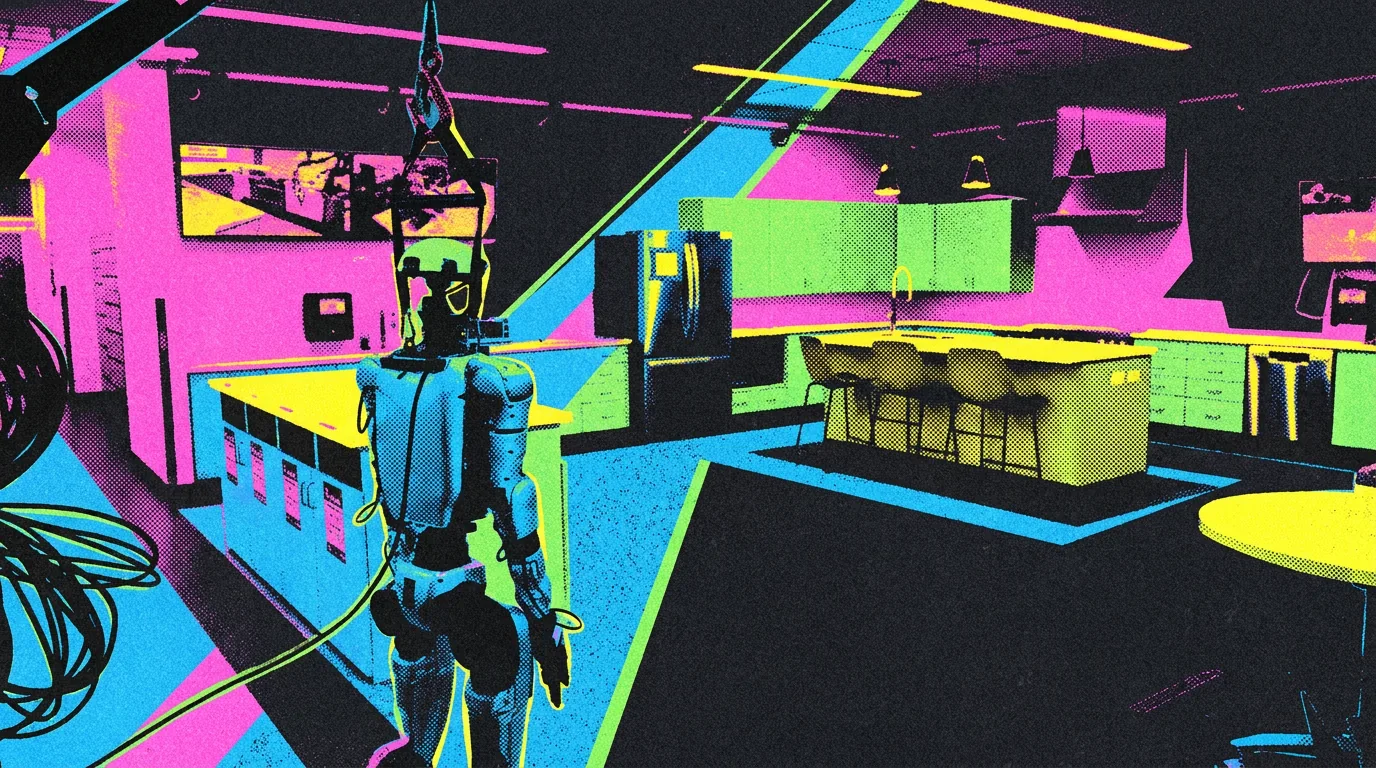
How HomeBody handled an unfamiliar kitchen
HomeBody was tested on a Unitree G1 humanoid placed in a kitchen it had not seen before. The assignment covered ordinary domestic work: move through the room, tidy misplaced objects and retrieve specific items stored in drawers. The robot received no room-specific training and worked from its own exploration of the space. The researchers have published the code on GitHub, so other groups can inspect and reproduce the setup. The project is presented as another test showing that GPT-6 Astra can drive a physical robot outside a fixed script.
The design drops the typical trained control layer between model and machine. Instead, a swappable vision-language model, in this case GPT Astra, calls directly into an extensible library of skills for grasping, navigation and opening drawers. Before acting, the robot explores the kitchen and builds a digital twin in Nvidia's Isaac Sim, then records objects and positions in spatial memory. That memory allows it to locate items even after they leave its field of view. For a broad command such as "clean up the kitchen," the language model breaks the job into steps, executes them in sequence and corrects itself when an action fails.
The experiment lands against two earlier signals about Astra. One benchmark pointed to greatly improved spatial reasoning, which is a precondition for finding and handling objects in a cluttered room. A separate test flagged safety issues when Astra controls a robot, which keeps questions of supervision and failure modes on the table. OpenAI has already announced plans to return to robotics, including systems for personal use. Taken together, the background explains why university labs are now probing how far a general model can go without custom middleware.
What this means for automation in business
For companies that automate physical operations, the practical point is a simpler path from instruction to action. If navigation, grasping and drawer opening can be exposed as callable skills, a warehouse team, a clinic or a small hotel could task a robot in plain language rather than commission a new control program for each room. Large firms gain faster redeployment across sites, while small firms gain access without a robotics department. The GitHub release supports that logic by letting internal engineers review the architecture and estimate integration effort before buying hardware.
The same setup carries clear limits that buyers should price in. The researchers cite latency in Astra, overheating finger servos on the hardware side and high compute costs for running the system. Latency affects response time in shared spaces, heat limits continuous grasping cycles, and compute affects operating cost per hour. The news by itself does not prove reliability across kitchens, lighting or clutter levels. Before any pilot, vendors should be asked about error rates, fallback behavior, data handling for room scans and the exact skill set supported on a given robot model.
A useful marker will be whether follow-up deployments run the same HomeBody approach in new rooms without code changes and with lower delay and cost. OpenAI moves toward personal robotics and independent reproductions using the GitHub code will show if the method transfers. If error correction holds up outside the demo kitchen, the direct model-to-skills pattern can be treated as a procurement option rather than a research demo.