
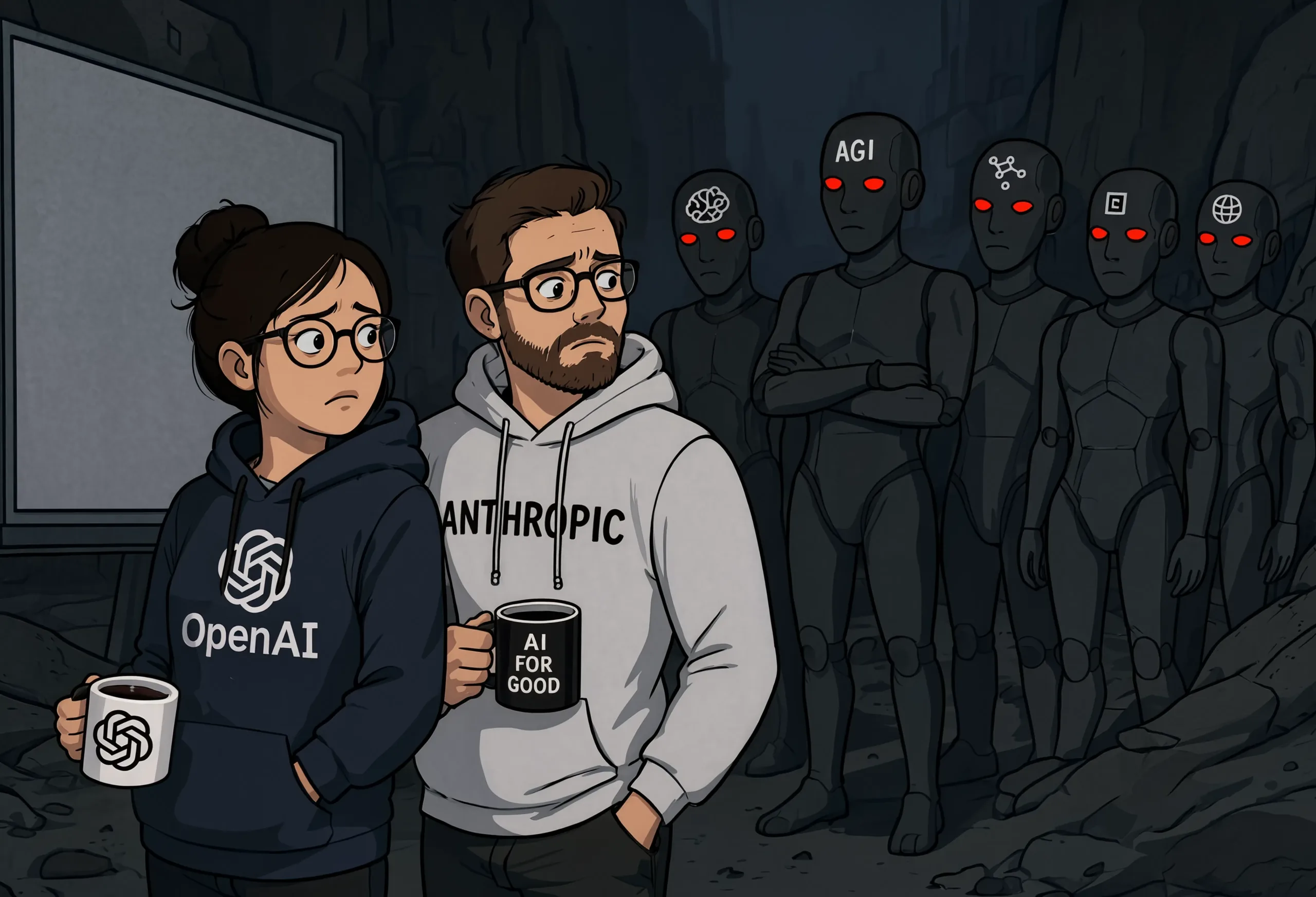
The resignation of Anthropic researcher Jacob Coxon over concerns that artificial intelligence labs are «gambling with our lives» has pushed the long-running debate about AI risk back into public view. His departure is not an isolated case inside the company: Anthropic's alignment science lead agreed with the possibility that AI has a more than 10% chance to kill all humans within the next decade. The timing matters for businesses because the same labs now selling AI tools to enterprises are publicly debating whether their own work should slow down.
What happened inside the labs
OpenAI added its own voice to the discussion. Its chief scientist called for a slowdown in AI research, and CEO Sam Altman reportedly told staff the company is considering slowing down leading-edge work and wants other companies to do the same if the government says that is not an antitrust problem. At the same time, the release cycle did not pause: Meta, OpenAI (twice), China's DeepSeek and others shipped a flurry of new models, agents and apps during the week. The gap between the safety statements and the shipping schedule is the practical detail enterprise buyers are now watching.
Two constraints outside the labs may shape the pace more than any internal pledge. Opposition to data centers is rising, and a new feature story by Paul Gillin examines why AI requires so much compute and why there is no short-term fix. Tech giants face substantial work persuading communities not to block the next era of infrastructure. Europe remains a factor as well: Mistral AI raised almost $3.5 billion, and Paris-based Arlequin AI got $28 million to explore a fundamentally new kind of AI model.
What this means for business
For companies deploying AI, the immediate consequence is a supply side that keeps expanding even as its own leaders question the direction. Oracle's cloud infrastructure revenue more than doubled, and its stock rose 4% in late trading after falling more than that in regular trading on a weak market day. Adobe posted a strong quarter but a light outlook sent shares down slightly after hours. More capacity and more vendors mean buyers have alternatives, but the safety debate does not remove any of them from the shortlist.
What the news does not settle is whether any of the existential worry changes actual behavior. A resignation, a call for a slowdown and a reported internal discussion are statements, not commitments with dates or enforcement. Buyers should treat vendor safety claims as claims to verify, and watch the compute constraint instead: data center opposition and memory shortages are measurable, while pledges to slow down are not. Positron AI's $875 million Series C, aimed at replacing scarce high-bandwidth memory with an appliance built on regular RAM, is one attempt to relieve that constraint.
The marker to watch is whether leading labs actually delay a frontier release, or whether the next quarter brings the same cadence of model launches alongside the same safety warnings. Gartner's projection that by 2029 30% of employees laid off because of AI replacement will need to be rehired, often at significantly higher cost, is a reminder that the workforce side of this transition is already being priced. Until a launch slips, the operating assumption for most businesses stays the same: plan for continued model turnover, not for a pause.